
The best math games for a child turn practice into something they choose on their own. Keep one story-driven app for screen time, then build the rest from pennies, dice, index cards, and a sheet of paper. This list starts with the single screen game worth keeping, then moves to hands-on, board, and free online games you can set up tonight.
I have watched a lot of children do math at a kitchen table, and the test that predicts whether a game sticks has nothing to do with graphics or grade labels. It is one question: whose idea is the next round? If you have to talk your child into it, the game is a worksheet wearing a costume. If your child reaches for it, you have found something real.
Ask any veteran teacher and you hear the same thing a different way. The games that build number sense are the ones that make a child explain their thinking, keep the cost of a wrong answer low, and stay short. Ten focused minutes beats an hour of grinding, because fluency is built by spaced, repeated practice, not by marathon sessions. That is why a game beats one more worksheet: the learning happens while a child is trying to win, not while they are being made to sit. Every pick below is chosen against that bar, and most run on things already in your kitchen.
What makes a math game worth keeping
A math game earns a spot in your house if it does four things.
The child controls the pace, not the clock
Fun dies the moment a child feels rushed into a mistake in front of you. Good math games let a child slow down, try again cheaply, and feel the win. That is why an easy reset and a difficulty you can dial matter more than any feature list.
It targets one skill at a time
Addition facts, the times tables, place value, multiplication, and division are separate jobs. A game that lets you aim at exactly the weak spot, say only the seven and nine multiplication tables, teaches more than one that sprays every operation at once.
It runs on what you already own
Dice, a deck of cards, a jar of pennies, and printer paper cover most of these ideas. Cheap materials mean you play more often, and frequency is the whole game. Frequent play is what turns drills into real learning.
A grown-up can join in thirty seconds
If setup needs a craft store run, it will not happen on a Tuesday. The games that survive are the ones you start before the pasta boils.
1. MathHero: the one screen game worth keeping
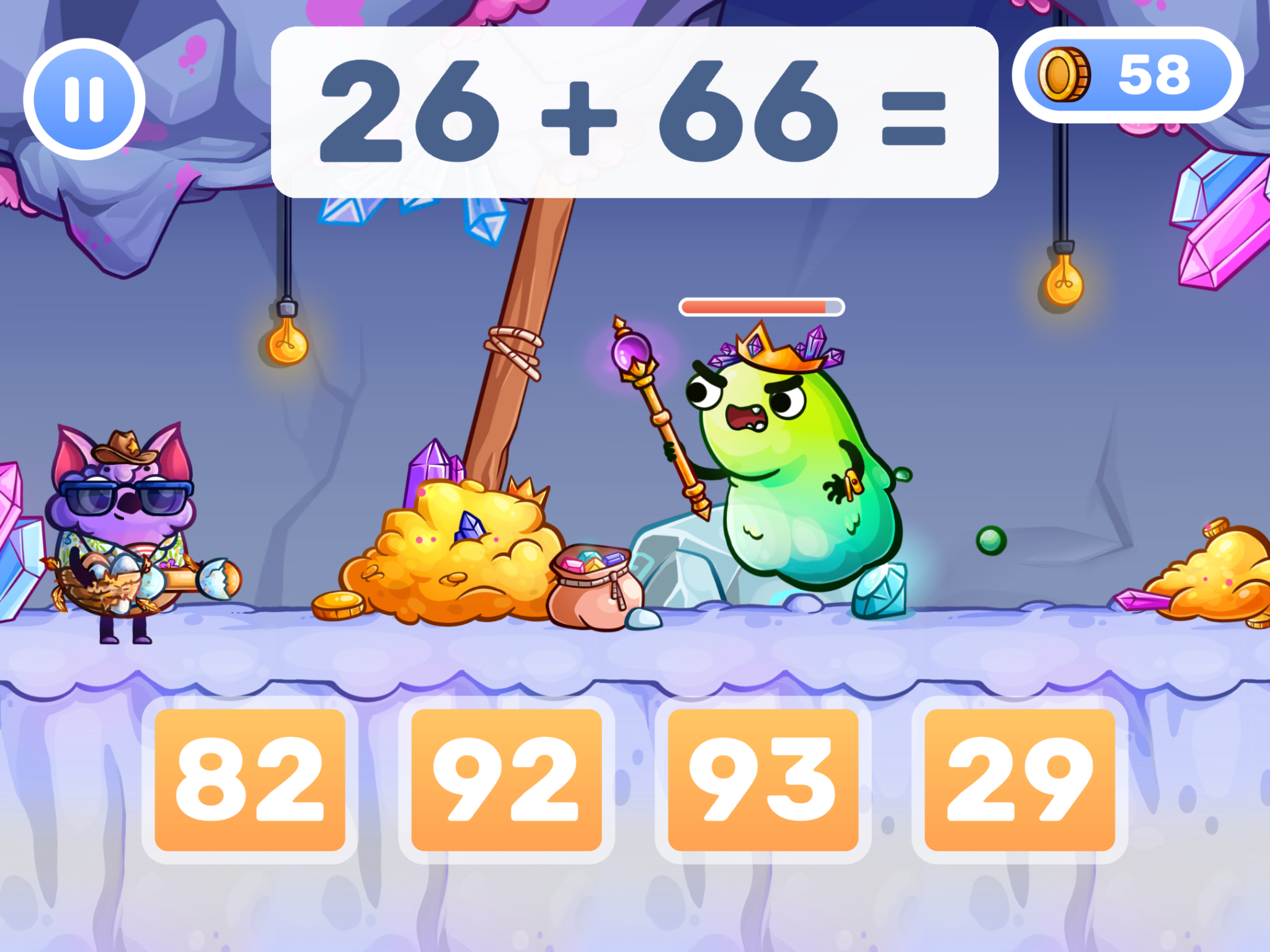
MathHero is a story-driven adventure where solving short sets of math facts is how you actually play. The child rescues characters, battles monsters, earns coins to spend and gear to collect for their hero, and every step forward runs on addition, subtraction, times tables, or division. The monsters only fall when the math is right. Math is the action, not a toll you pay to reach the fun part. That is what separates it from a drill wearing badges.
You can get MathHero here. It is built for children ages 5 to 10, roughly kindergarten through fourth grade in the US school system, starting at first addition within 10 and running up through multiplication, division, and arithmetic to 1000, the core mental-math curriculum for those years.
What you control as the parent
This is where MathHero pulls ahead. You choose the topic, the difficulty, whether the answer is typed or multiple choice, and how fast the monsters move. Each child gets a profile with its own settings, so a first grader on addition and subtraction and a fourth grader on the multiplication tables share one game without stepping on each other. Parents in reviews name this fine-grained control as the thing rival apps miss.
Free, five levels a day
You can complete the whole game for free. Not a demo, no locked chapters, no ads: the only limit is pace at five levels per day. That cap is not a trick. It is close to how daily practice should look, a short regular session rather than a binge. A subscription with a free trial lifts the daily limit if your child wants more. Prices for app subscriptions change, so confirm the current figure in the app before you buy.
What it does not do
MathHero does not teach counting or number recognition from scratch, and it does not cover fractions, geometry, or video lessons. Your child should already know their numbers before starting. Inside its lane, core arithmetic for ages 5 to 10, it goes deep. Across US stores it holds Google Play 4.6 (46k ratings) and App Store 4.7 (11k ratings). For more ways to keep practice light, MathHero’s guide on how to make math fun pairs well with the homemade games below.
2. A place value race with a jar of pennies
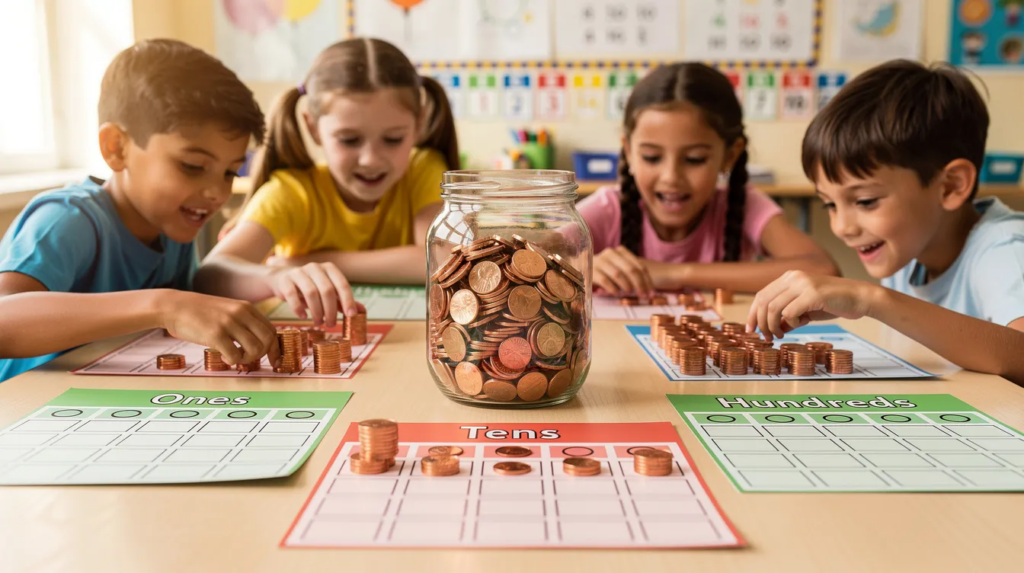
Place value is the idea that a digit’s spot decides its worth, and pennies teach it faster than any explanation. Grab a handful of pennies, a few dimes, and a paper mat with two columns marked tens and ones.
How a round goes
Each player rolls a die and takes that many pennies into the ones column, then passes the die on. The rule that does the teaching: the moment you collect ten pennies, trade them for one dime and slide it to the tens column. First person to reach fifty, five dimes, wins. Your child feels regrouping in their hands instead of memorizing it, which is exactly why base ten finally clicks. Because it runs on coins, children pick up a first lesson about money too.
Make it harder
Add a hundreds column and a dollar coin, roll two dice, and now you are trading up through three places. For an older child, run it backward: start at a new number like 100 and subtract each roll, breaking a dime into ten pennies whenever the ones column runs dry. Subtraction with borrowing stops being a mystery. Games like this help children master concepts like base ten and counting money that a worksheet only labels. The learning sticks because their hands did it.
3. Multiplication Bingo
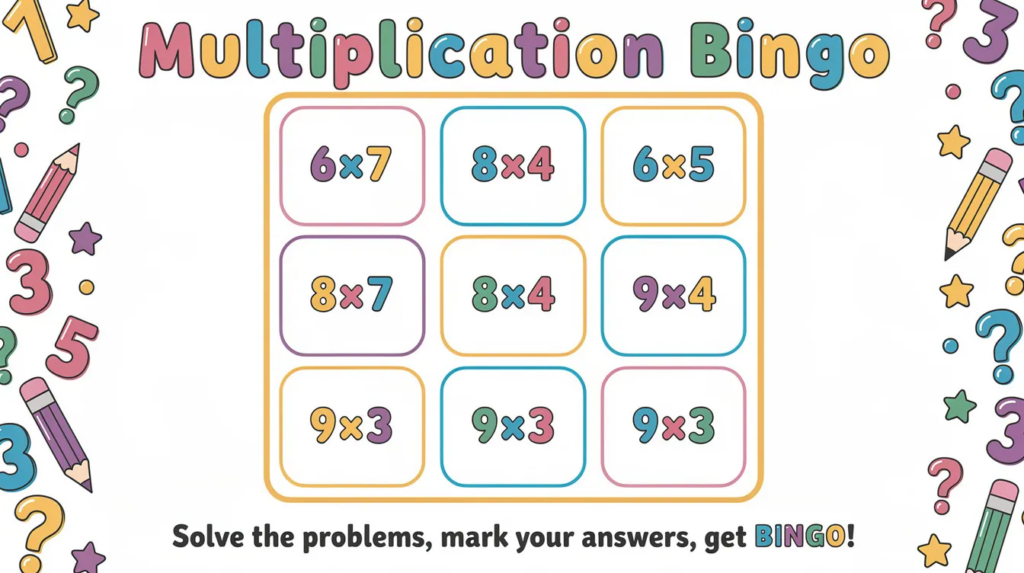
Bingo turns the times tables into a game of luck plus recall, and it is the fastest way I know to make multiplication drill feel like play. Draw a grid of twenty-five squares and write a product in each of the squares, say 24, 42, 56, for example. Everyone gets a different card, and you can print blank grids if drawing them is a chore.
You call out a fact, “six times seven,” and any player whose card holds that product covers the square with a penny and calls the answer out loud. First to a full row, column, or line of corner squares wins. Because children hunt for the correct answer on their own squares, they run the multiplication in their head without being told to. Swap the products for sums or differences and the same squares drill addition and subtraction instead.
4. Fact family triangles
A fact family triangle is one card that teaches four facts at once, and it is a quiet powerhouse for multiplication and division. Cut a triangle from an index card. Write a product in the top corner and its two factors in the bottom corners, for example 8 and 7 at the bottom and 56 on top.
Why one triangle does four jobs
Cover the top corner and your child multiplies the two factors. Cover a bottom corner and they divide. One triangle holds the whole family: seven times eight, eight times seven, 56 divided by seven, 56 divided by eight. Children see that multiplication and division are the same relationship read two ways, which is the insight that makes division stop feeling like a brand new subject. Build a stack of triangles, deal them out, and race to clear each triangle by saying all four facts. Fact family triangles are the fastest path to division fluency I know, since every triangle is a division fact and its multiplication twin. The same triangle card works for addition and subtraction: put the sum on top and the two parts below.
5. Build your own math board game
This is the craft project that becomes a math game, and it is pure Kids Turn Central territory. On a big sheet of poster paper, draw a winding path of about forty squares from a start line to FINISH. Add a few ladders that jump you forward and a few slides that send you back, chutes and ladders style. Let your child create the board and color every slide.
The math twist
Here is the change that makes it a math game and not a dice game: before you move, draw a fact card and solve it. Get it correct, you roll and move. Miss it and you pass your turn to the next player. Land on a ladder, you jump ahead. Land on a slide, and the slide sends you back down the board. Because your child helped create the board, drew the squares, and painted the slides, they are invested before the first roll. The creativity does half the work, so lean into it: a jungle map, a space station, an underwater world, whatever theme they create. Two long slides and three short ones keep the game swingy enough to stay tense.
Scaling it to your child
Fill the fact cards with whatever they need: addition within 20 for a five year old, long division for a fourth grader. One board, any skill, and you rebuild the deck as they grow. It is the most flexible math game you will ever create, and the least expensive.
6. Math War with a deck of cards
Math War takes the classic card game and bolts on one operation, and it is the lowest effort game on this list. Split a deck between two players. Each person flips two number cards at once. The higher first number does not decide it, since the sums are what you compare. Whoever’s sum is higher collects all four cards. Run out of cards and you lose.
Children practice adding two numbers dozens of times per game and never notice, because they are chasing the pile. Change the operation to fit the week: multiply the two cards for a times table round, or find the difference for subtraction. Face cards can be ten and the ace can be one, or drop them for a cleaner deck. It is thirty seconds of setup for twenty minutes of practice, which is why it survives the busiest school nights.
7. Target Number (a free take on the 24 Game)
Target Number is one of those four-card number puzzles that push children to combine operations to hit a goal, and it builds the flexible thinking that timed drills never touch. Deal four number cards. Players race to use all four, with any mix of add, subtract, multiply, and divide, to reach a chosen target. The classic boxed version, the 24 Game, fixes the target at 24 and ships as a set of number cards. If you want it, check the current price online first. You do not need it: a deck of cards and a target you pick yourself does the same job for free.
Flip 3, 4, 6, and 8 with a target of 24, and a child will guess and check their way there: three times eight is 24, and now what about the six and the four? That trial and error, testing a path and abandoning a wrong one, is real problem solving. It is the closest a card game gets to the math problems children meet in word problems, and it is one of the best puzzles for kids who finish their homework fast and want a challenge.
8. Math Playground: hundreds of free online math games
When you do want a screen and MathHero’s daily levels are spent, Math Playground is the free online math games site I point parents to. It offers more than 300 free math games for grades K through 6, covering addition, subtraction, multiplication, division, fractions, and decimals, plus logic puzzles that stretch problem solving. The games are designed to support Common Core and state standards, so they line up with the school curriculum, and nothing needs a sign-in or a download: you click and play in a browser. That free access is why experienced math teachers reach for it during classroom math centers too. Games like these reinforce classroom learning through play.
Two honest caveats. The free site runs ads (a paid ad-free version exists, so check the current price if that matters), and with hundreds of games the hard part is choosing, so send a young child straight to one specific game, its fractions and multiplication sets are a good place to start, rather than the front page.
9. Math scavenger hunt
A math scavenger hunt gets a restless child moving while connecting numbers to the real world, and it is the antidote to a child who has been sitting too long. Write a list of missions and send them hunting through the house or backyard: find three things shaped like a triangle, name that shape, count the windows and double it, find two numbers on food labels and add them, hop up the stairs while counting by fives.
Why movement helps
Active math games pair physical coordination with quick thinking, and the hunt ties each problem to something a child can hold or point at, which is what “real world math” actually means. For a group, split into a red team and a blue team, and let each team race the same list around the house. Team scoring keeps it friendly, and a wrong count sends that team back to check. For one child, beat the clock. Either way they are calculating on their feet, and nobody is asking them to sit still.
Quick comparison of these math games
A fast way to match a game to tonight.
|
Game |
Best for |
What you need |
Skill focus |
|
MathHero |
A screen game children replay by choice |
Phone or tablet |
Addition, subtraction, multiplication, division |
|
Penny place value race |
Making base ten click |
Pennies, dimes, dice |
Place value, regrouping, money |
|
Multiplication Bingo |
Painless times table drill |
Paper grid, pennies |
Multiplication |
|
Fact family triangles |
Linking multiply and divide |
Index cards |
Multiplication, division |
|
Homemade board game |
A craft that becomes practice |
Poster paper, dice |
Any operation |
|
Math War |
Zero prep on a busy night |
A deck of cards |
Addition, subtraction, products |
|
Target Number |
Flexible problem solving |
A deck of cards |
Mixed operations |
|
Math Playground |
Extra free online math games |
A browser |
K to 6, all topics |
|
Math scavenger hunt |
A child who needs to move |
A list, a pen |
Real world math |
How to choose the right game for your child
Match the game to the child in front of you, not to a grade on a box.
Choose by age and stage
For a five or six year old, start with the penny place value race, Math War, and the scavenger hunt: concrete, physical, forgiving, and strong for early addition and subtraction. For eight to ten year olds moving into the multiplication tables and division, Bingo, fact family triangles, and Target Number carry more weight. MathHero spans the whole 5 to 10 range because you set the difficulty yourself.
Choose by the skill that is wobbling
Pick the weak spot, then pick the game. Shaky on place value? The penny race. Times tables or division not automatic? Bingo and fact triangles. Freezes on multi-step math problems? Target Number and the puzzles like it. If fractions or decimals are the gap, that is Math Playground’s territory, since fractions sit just past what the homemade games here cover. Any teacher will tell you the same thing: aiming one game at one skill beats a scattershot approach every week.
Choose by how much fight you have left
Some nights you have craft energy and build a board. Most nights you do not, and Math War or a MathHero session is the honest choice. The best math game is the one you will actually start, so keep a no-setup option in reach and let the learning ride on the fun.
Common questions
What are the best math games to play at home?
The best math games at home mix one story-driven app like MathHero with hands-on games built from household items: a penny place value race, Multiplication Bingo, fact family triangles, a homemade board game, Math War, and a math scavenger hunt. Short, frequent sessions of ten to fifteen minutes, say right after school, work better than long ones. Most of them drill addition and subtraction without a worksheet in sight.
Are there good free online math games?
Yes. MathHero is free to play with a limit of five levels per day, and Math Playground offers more than 300 free online math games for grades K through 6 with no sign-in. Homemade games using dice, cards, and pennies cost nothing at all.
What math games teach place value?
A penny and dime trading game teaches place value best: children trade ten pennies for a dime, then a column of dimes for a dollar, so they feel regrouping instead of memorizing it. Any game that forces trading between ones, tens, and hundreds builds base ten understanding.
Do board games really help children learn math?
Yes. A board game turns math into social play with a low cost for a wrong answer, and building your own board adds a hook of pure creativity that keeps children at the table. Attaching a fact card to each turn converts a plain roll and move game into genuine practice.
How much should a young child practice math each day?
Ten to fifteen minutes a day of focused practice beats one long weekly session, because lasting learning comes from spaced repetition, not marathons. That is why MathHero’s five levels a day works as a daily rhythm rather than a limitation.
The real win is not any single game on this list. It is the night your child asks to play one of them before you have said a word.